
There’s a moment somewhere near the top of Machu Picchu Mountain where the clouds part, the ancient citadel appears far below, and your brain simply stops working.No photo does it justice. No travel documentary comes close. You just stand there, heart pounding from the climb, completely speechless.
But getting to that moment? That takes a little planning.
This guide covers everything: the views, both mountains, the best tours, and exactly how to plan your trip so you don’t miss a single thing.
What Is the View from Machu Picchu Mountain Like?
Let’s start with the big question: what do you actually see up there?
From the summit of Machu Picchu Mountain (locally called Montaña Machu Picchu), the entire Inca citadel spreads out below you like something out of a dream. You’re looking down at the terraces, the temples, the plazas all perfectly framed by the jagged Andean peaks and the winding Urubamba River snaking through the valley far beneath.
It’s not just a view. It’s a whole new way of understanding the place.
The Sunrise Experience
If you can get up there early, do it.Watching the sun rise from Machu Picchu Mountain is an experience that words genuinely struggle to capture. The moment that first light touches the ancient stonework, everything turns a warm, soft gold and down in the valleys below, the morning mist drifts silently through the landscape like something from a painting. You keep waiting for someone to yell “cut” but there’s no film crew. No set. Just you, the mountains, and one of the most breathtaking mornings you’ll ever have.
The Sunset Experience
Sunset brings its own kind of magic. The light turns warm and amber, shadows stretch long across the terraces, and the crowds that filled the citadel earlier have mostly thinned out. It’s quieter, softer, and in many ways, even more beautiful.
Higher vs. Lower Does the Height Actually Matter?
Short answer: yes, a lot.
From the lower sections of the trail, you get decent views but they’re partial. You see parts of the ruins, some of the surrounding mountains, a slice of the valley. It’s nice, but not the full picture.
From the summit? Everything opens up. You see the full layout of the citadel, the surrounding peaks, the river valley, and the scale of the entire landscape. It’s the difference between looking through a window and standing on the roof.
Is It the Best View in Machu Picchu?
Yes, Machu Picchu Mountain offers the most complete, panoramic view of the entire archaeological site. While Huayna Picchu is more dramatic and positions you closer to the ruins, the summit of Machu Picchu Mountain sits higher and gives you a wider, fuller perspective. If you want the best overall view, this is it.
Huayna Picchu & Machu Picchu Mountain Explained (Quick Overview)
Not sure which mountain is which? Here’s everything you need to know about both.
Machu Picchu Mountain (Montaña Machu Picchu)
- Height: 3,082 meters (10,111 feet)
- Difficulty: Moderate to challenging
- Hike time: Around 1.5–2 hours up, 1–1.5 hours down
- Best for: Travelers who want the most panoramic, complete view of the citadel and surrounding landscape
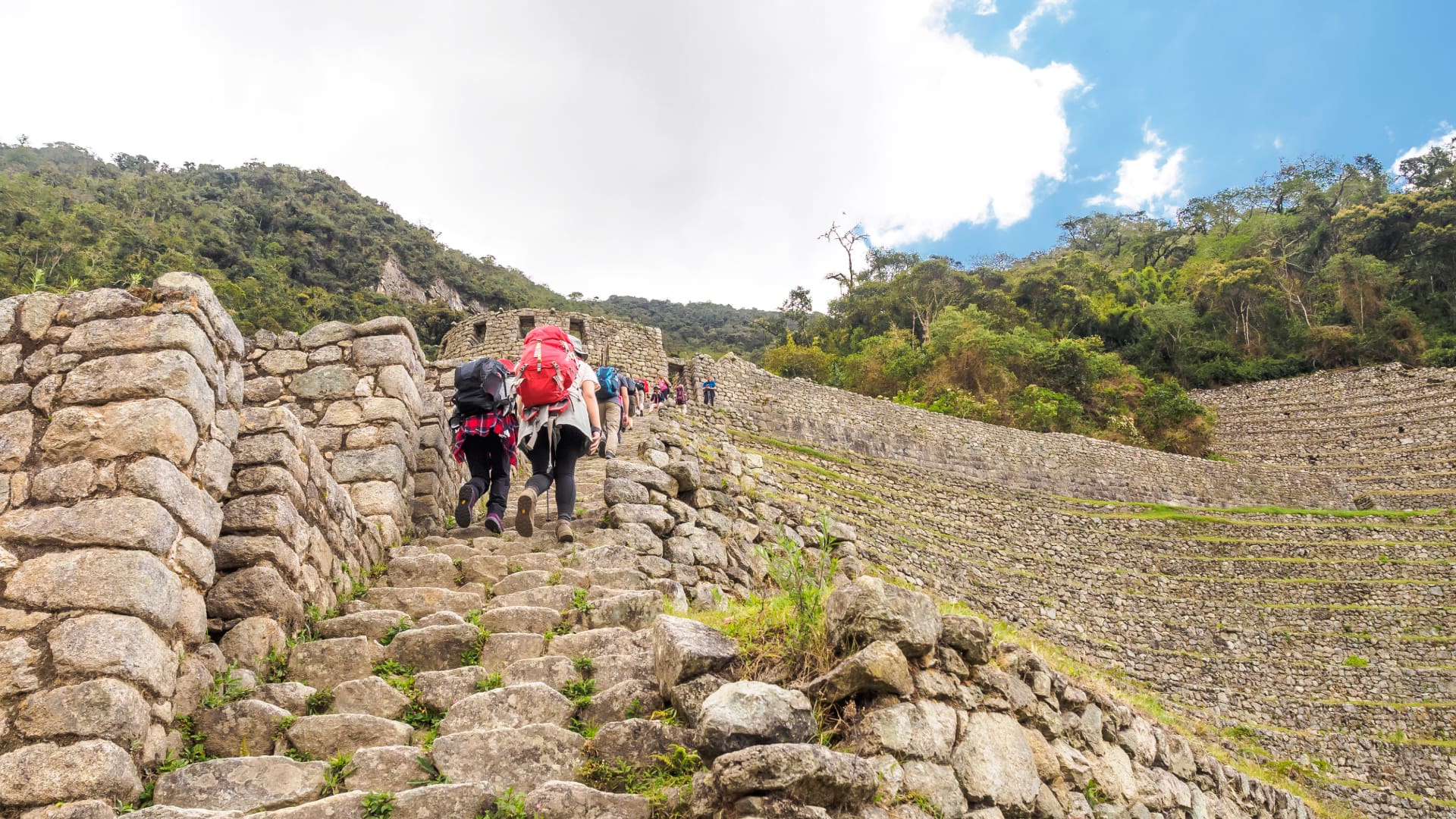
- The honest take: It’s a real workout steep in places, with uneven stone steps but the payoff at the top is absolutely unmatched. This is the one that leaves people speechless.
Huayna Picchu
- Height: 2,693 meters (8,835 feet)
- Difficulty: Challenging (sometimes very challenging)
- Hike time: Around 1–1.5 hours up, 45 minutes–1 hour down
- Best for: Thrill-seekers, adventurous hikers, and photographers who want a dramatic, close-up perspective of the ruins
- The honest take: This one is steep, narrow, and genuinely intense in places. Some sections require using chains and fixed ropes. Not for anyone with a fear of heights but if you can handle it, the views are jaw-dropping in a completely different way.
Comparison Table: Huayna Picchu vs. Machu Picchu Mountain
Feature | Machu Picchu Mountain | Huayna Picchu |
Height | 3,082m (10,111 ft) | 2,693m (8,835 ft) |
View Quality |
|
|
Difficulty | Moderate–Hard | Hard–Very Hard |
Hike Time | 3–4 hrs total | 2–2.5 hrs total |
Daily Permits | 800 per day | 400 per day |
Best For | Best overall view | Thrill-seekers & photographers |
Instagram-Worthy? | The classic postcard shot | Dramatic & unique angles |
Crowds | Moderate | Lower (strict permit limits) |
Fear of Heights? | Manageable | Not recommended |

One thing most guides don’t tell you: Because Huayna Picchu has stricter daily limits, it actually feels less crowded at the top even though it’s the more famous of the two. If solitude matters to you, that’s worth knowing.
Which Mountain Has the Best View Huayna Picchu or Machu Picchu Mountain?
Honestly, this is the question every traveler asks and the answer isn’t as simple as picking a winner. Both mountains will stop you in your tracks. They just do it in completely different ways.
For the best overall view → Machu Picchu Mountain
Imagine standing on a summit so high that the entire ancient citadel fits inside your field of vision. The ruins, the terraces, the surrounding Andean peaks, the Urubamba River winding through the valley far below all of it, at once, in one single frame. There’s a reason people stand at the top of Machu Picchu Mountain and just go quiet. It’s not just a view. It’s the kind of perspective that makes the whole place finally make sense why here, why this shape, why the Incas chose this exact spot in the middle of the mountains. Wide, sweeping, and the kind of sight that genuinely stays with you.
For the most dramatic, up-close view → Huayna Picchu
Huayna Picchu gives you something entirely different and equally unforgettable. You’re not looking at Machu Picchu from a distance here. You’re practically above it, perched over the ruins like a bird on a cliff edge. The angle is steep, the drop is real, and the feeling of hovering directly over the terraces is unlike anything you’ll experience from anywhere else. It’s intense. It’s dramatic. And for the right kind of traveler, it’s absolutely perfect.
So which should you choose?
- Choose Machu Picchu Mountain if you want the best full view, you’re moderately fit, and this is your first visit
- Choose Huayna Picchu if you’re an experienced hiker, love adventure, and want a more dramatic, intimate perspective
- If you have two days? Do both. They offer completely different experiences, and together they give you Machu Picchu from every angle imaginable.
Best Machu Picchu Tours for Mountain Views
Going solo is possible but a good tour can completely transform your experience. Here’s what’s available.
Machu Picchu Tours (Best for First-Timers)
What’s included: Entry tickets, a licensed guide, hotel pickup in some cases, and a structured itinerary
Best for: First-time visitors who want context, history, and someone to handle all the logistics
What makes it worth it: A great guide doesn’t just walk you around they bring the entire place to life. You’ll understand why the Incas built it here, how they did it without modern tools, and what each section of the citadel was actually used for. That context makes the views hit completely differently.
Choose this if you want the full experience, views AND understanding.
Adventure Tours (Best for Mountain Hikers)
What’s included: Guided Machu Picchu Tours mountain hike (Machu Picchu Mountain or Huayna Picchu), entrance permits, sometimes trekking gear
Best for: Active travelers, hikers, and anyone who wants to genuinely earn their view
What makes it worth it: These tours are built entirely around the hike, not just the site. You’ll get a guide who knows the trail inside out the best rest spots, the trickiest sections, and exactly where to stand for the shot you came for.
Choose this if the mountain hike is the main event for you.
Luxury Tours (Best for a Premium Experience)
What’s included: Private guide, premium transport, exclusive timeslots, high-end accommodation in Aguas Calientes
Best for: Travelers who want to experience Machu Picchu without the crowds, queues, or logistics stress
What makes it worth it: Machu Picchu with a private guide, at your own pace, with sunrise access before the crowds arrive it’s a completely different experience from the standard visit.
Choose this if you want Machu Picchu the way it’s truly meant to be seen.
How to Plan Your Trip to Machu Picchu
Getting There
The most common route goes like this:
- Fly into Cusco — the nearest major city and a fascinating destination in its own right, you can check machu picchu day trip from cusco.
- Train from Cusco or Ollantaytambo to Aguas Calientes — the gateway town to Machu Picchu. The train ride through the Sacred Valley is stunning in itself
- Bus from Aguas Calientes up to the entrance — a 25-minute winding ride up the mountainside
Some adventurous travelers choose to hike the Inca Trail instead, a 4-day trek that ends dramatically at the Sun Gate directly above the citadel. Worth every step if you have the time and fitness.
Tickets and Permits
This is where many travelers get caught out, tickets sell out fast, especially during peak season.
- Machu Picchu entry tickets must be booked in advance through the official government portal
- Mountain permits for both Machu Picchu Mountain and Huayna Picchu are sold separately and have strict daily limits — Huayna Picchu especially fills up months ahead
- Book at least 2–3 months in advance for peak season (June–August), and even earlier for Huayna Picchu
Suggested Itinerary
Got just 1 day? Get there early, see the citadel with a guide, and finish strong with the hike up Machu Picchu Mountain. You’ll leave with the full panoramic view locked in your memory.
Got 2 days? Day 1 is all about the citadel, take your time, soak it in, then tackle Machu Picchu Mountain for that sweeping summit view. Save Day 2 for Huayna Picchu, where the perspective gets dramatic, close, and genuinely thrilling.
Got 3 days? Now you can breathe. After the mountains, spend a slow morning in Aguas Calientes, dip into the hot springs, wander the town, and when you’re ready, hop on the scenic train back through the valley at your own pace. No rushing, just memories.
Best Time to Visit for the Best Views
Weather by Month
- May–September (Dry Season): Peak season for good reason. Clearer skies, less rain, and significantly better visibility from both mountain summits. June–August is the busiest but most reliable period.
- October–April (Wet Season): More rain and clouds, but fewer tourists and dramatically lush, green landscapes. Views from the mountains can be unpredictable — but when they clear, they’re stunning.
Cloud Coverage
Cloud coverage is the wild card at Machu Picchu. Even in the dry season, mornings often start misty and clear by mid-morning. The mist itself is actually iconic; the sight of clouds drifting through the ruins is one of the most photographed scenes in the world. But if you want clear summit views, aim to reach the top by 9–10 AM.
Sunrise Visibility
For the best sunrise experience from Machu Picchu Mountain, start your hike in the dark around 5:00–5:30 AM. Yes, it’s early. Yes, it’s completely worth it. The first light touching the ruins from above is something you’ll carry with you for the rest of your life.
Photography Tips: How to Get the Best Shots
The Best Angles from Each Mountain
From Machu Picchu Mountain summit: Wide-angle shots are your best friend here. Capture the full citadel below with the surrounding Andean peaks framing the scene this is the classic postcard perspective, and it never gets old.
From Huayna Picchu: You’re closer and lower, positioned almost directly above the ruins. This gives you a more intimate, intense composition great for dramatic shots where the terraces fill the foreground and the mountains rise behind.
Best Timing for Photos
- Sunrise (5:30–7:00 AM): Soft golden light, minimal crowds, mist drifting through the valleys this is the magic hour and worth every early alarm
- Late afternoon (3:00–5:00 PM): The light turns warm and amber, shadows grow dramatic, and most tour groups have already headed back down
- Avoid midday: Harsh overhead light, maximum crowds, and flat, washed-out colours.